Seconda linea di resistenza della Valtellina (1915-1918)
The Valtellina Second Defensive Line
Zweite Verteidigungslinie des Veltlins

Visconti Venosta Hospice: the Field Hospital No. 112
The hospice, owned by the Visconti Venosta family, was founded by Emilio and Maria Luisa Alfieri di Sostegno in memory of a daughter who died prematurely, and inaugurated on 5 October 1891. During the Great War it served as a military hospital for soldiers arriving from the Stelvio front. It was run by the 3rd Medical Company (Milan), Unit 112, established in February 1917, as recorded in a document from the period.
Enclosure No. 5, Valtellina Subsector Command, registered no. 206, 12 February 1916
To all subordinate commands, units and services
Subject: Grosio Military Hospital.
As of the 10th of this month, a military hospital has been operating in Grosio in the premises of the “Visconti Venosta” Hospice. By order of the Medical Office of the 5th Division, patients requiring hospital care whose illness is expected to last some time must henceforth be sent to this hospital rather than to the Reserve Hospital in Sondrio. The Bormio infirmary is reserved for patients whose illness is expected to be brief and for those in serious condition for whom transport could be harmful.
The Acting Lieutenant Colonel Commanding the Subsector
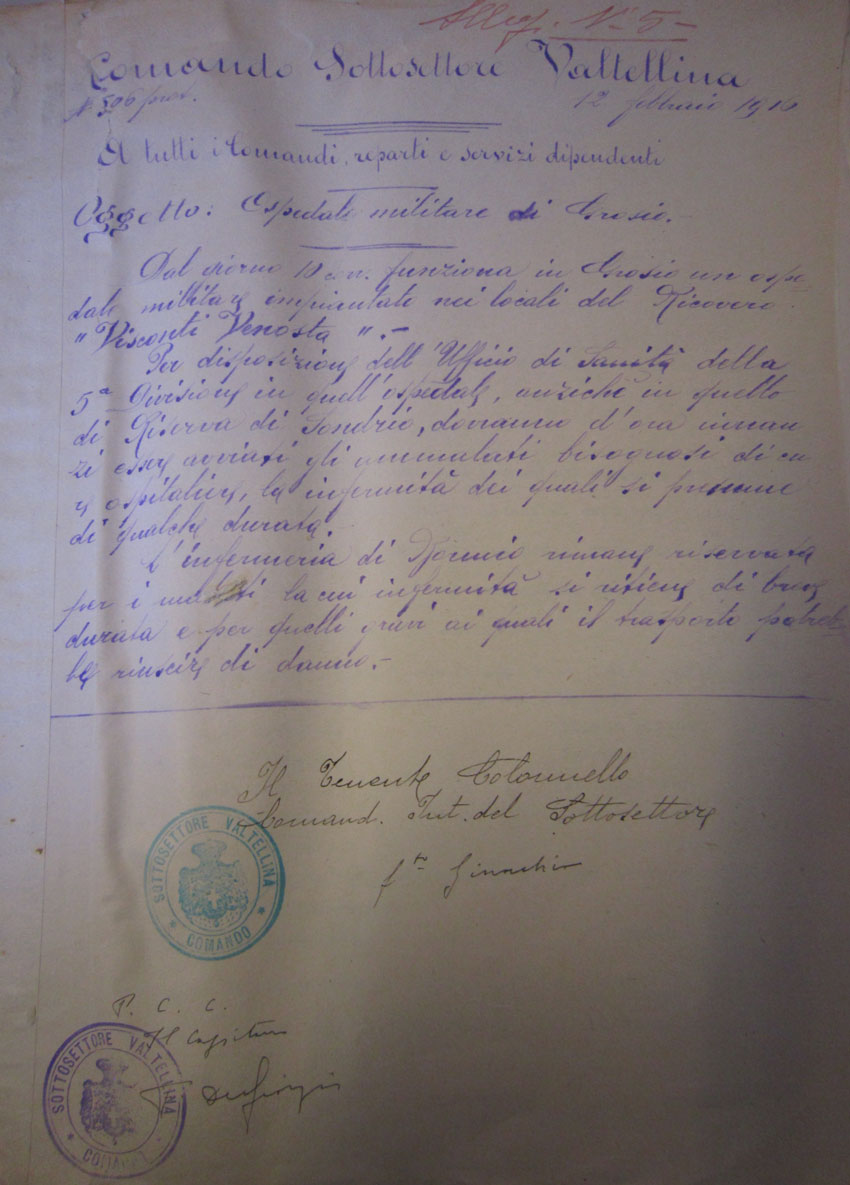
The historical document*
In addition to the historical photograph displayed on the information board, showing one of the vehicles used to bring soldiers here for treatment, many period images document this place and some of its wartime inhabitants. They come from Captain Soika’s photographic album, a copy of which is held at Villa Visconti Venosta.
Two rather unusual admissions connected with this building are worth recalling. The first concerns the transport of Private Francesco Valenti after he slipped on the ice while carrying away manure from the animals. The fall caused a sprain of the tibio-talar joint, with an estimated recovery time of 20–25 days.
The second concerns Private Melchiorre Macchi, who arrived at this field hospital “in a completely drunken state” and was admitted. However, the report notes that he would certainly face consequences once discharged! Under the military criminal code of war, being drunk on or off duty was punishable by up to five years’ imprisonment.
SUBJECT Private Francesco Valenti
Enclosures: 2
To the Tirano Stage Command
Bolladore, ~~16 December~~ 21 January 1917
On the afternoon of the 19th of this month, at about 4 p.m., Private Francesco Valenti, who together with Corporal Giacomo Scolari was on stable guard duty at Tiolo, was making fresh bedding for the animals. While carrying a barrow of manure out of the stable, he slipped on the ice and fell; the loaded barrow struck his right foot at the ankle. His companion came to his aid and carried Valenti to the sleeping quarters, where he was put to bed. When I arrived in Tiolo at that moment and examined him immediately, he complained only of severe soreness in the area. Rest was therefore prescribed.
The following day, however, as the foot had become extremely swollen, I sent him to Field Hospital No. 112. The doctor who examined him diagnosed a sprain of the right tibio-talar joint, expected to heal within 20 to 25 days.

The historical document**
DIRECTORATE OF THE MAIN MILITARY HOSPITAL OF MILAN — FIELD HOSPITAL NO. 112
SUBJECT: Private Melchiorre Macchi
To the Tirano Stage Command, Bolladore Detachment
11 January 1917
I inform this Command that Private Melchiorre Macchi reported to this Field Hospital at 7 p.m. for admission, carrying a valid sick-leave certificate, but in a completely drunken state.
To prevent further incidents, we kindly ask that, whenever possible, sick soldiers be accompanied.
This Directorate reserves the right to take disciplinary action against the soldier once he is discharged.

The historical document***
After the war, the building was used as a hospital and became known as the “Visconti Venosta Civil Hospital” (1963), while continuing to serve its original purpose of caring for older people. In 1975, when hospital services moved to Morelli Hospital in Sondalo, the building began to be used solely for elder care.
In 1985, after the death of Marchesa Margherita Pallavicino Mossi, the last heir of the Visconti Venosta family, the Municipality of Grosio purchased the building. It is still called the Visconti Venosta Retirement Home and is managed by the foundation of the same name.
* Source: Stefano Zazzi Archive.
** Source: Rodigari, M. (2026), Dreams of a Soldier: Life and Logistics of the White War between Tirano and the Peaks of Upper Valtellina, p. 324. Bormio: Alpinia Editore.
*** Source: Rodigari, M. (2026), Dreams of a Soldier: Life and Logistics of the White War between Tirano and the Peaks of Upper Valtellina, p. 42. Bormio: Alpinia Editore.

Con il contributo di


Con il contributo di

Iniziativa patrocinata e sostenuta dalla Provincia di Sondrio