Seconda linea di resistenza della Valtellina (1915-1918)
The Valtellina Second Defensive Line
Zweite Verteidigungslinie des Veltlins
The Fortress of Grosio
In the area around Grosio, both in the village and in the surrounding mountains, many remains of the First World War can still be found: trenches, communication trenches, and defensive works built of concrete or cut into the rock. Constructed between 1916 and 1918, these structures are a valuable record of local history and of the relationship between war, landscape and community. Today, however, many are overgrown and threatened by deterioration and neglect.
The Fortress of Grosio project aims to recover, secure and enhance this heritage, preserving its historical and human significance and making it accessible again in a respectful and sustainable way. Through volunteer work, historical research and collaboration with the local community, the project seeks to return these places to the public as spaces for remembrance, learning and reflection. Planned activities include clearing and restoring trenches and communication routes, securing the most critical access points, beginning to interpret the sites through information panels and signs, and creating routes for educational and cultural visits.
The Fortress of Grosio is a practical commitment to safeguarding the past and passing it on to future generations, so that its memory is not lost.
The Fortress of Grosio – Information Board
The decision to build a defensive barrier at Grosio and Grosotto was based on the terrain and military strategy. Near the hamlet of Tiolo, the valley narrows, making it suitable for an additional defensive system to stop an enemy advancing from Upper Valtellina. Such an advance could have bypassed the second defensive line at Le Prese through the Val di Rezzalo or the Val Grosina. A double line of defence was therefore built upstream of the entrance to the valley of the same name, to block a possible enemy advance from that direction and connect with the Valtellina barrier at Monte Storile. From Monte Varadega, a military mule track also linked the Grosio defensive line with the third line of defence in Valcamonica, which ascended from Incudine, and with Mortirolo.
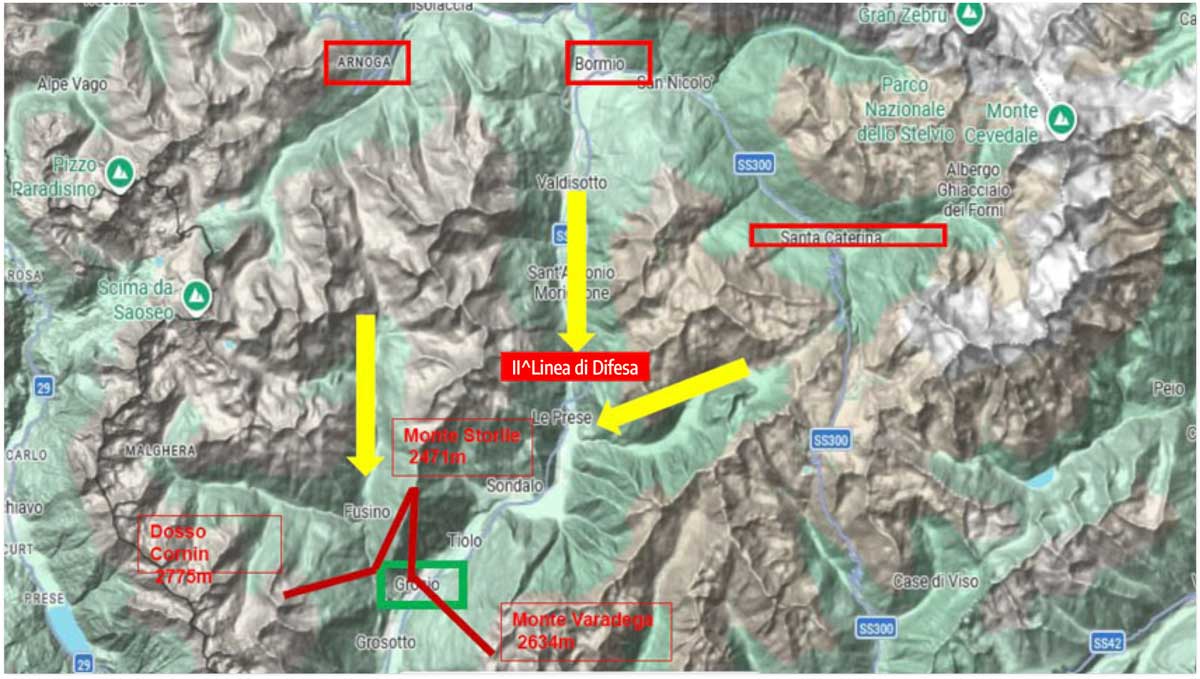
The three defensive lines in Valtellina
Grosio was also an important rear-area centre. A field hospital was located near Villa Visconti Venosta, alongside the hospice of the same name; there was also a store where soldiers could buy food for their rations and a bakery that supplied their bread. In addition, the Grosotto and Grosio hydroelectric power stations—the latter still under construction at the time—were essential to the logistics and industry of the area and therefore had to be camouflaged and protected from enemy attacks.
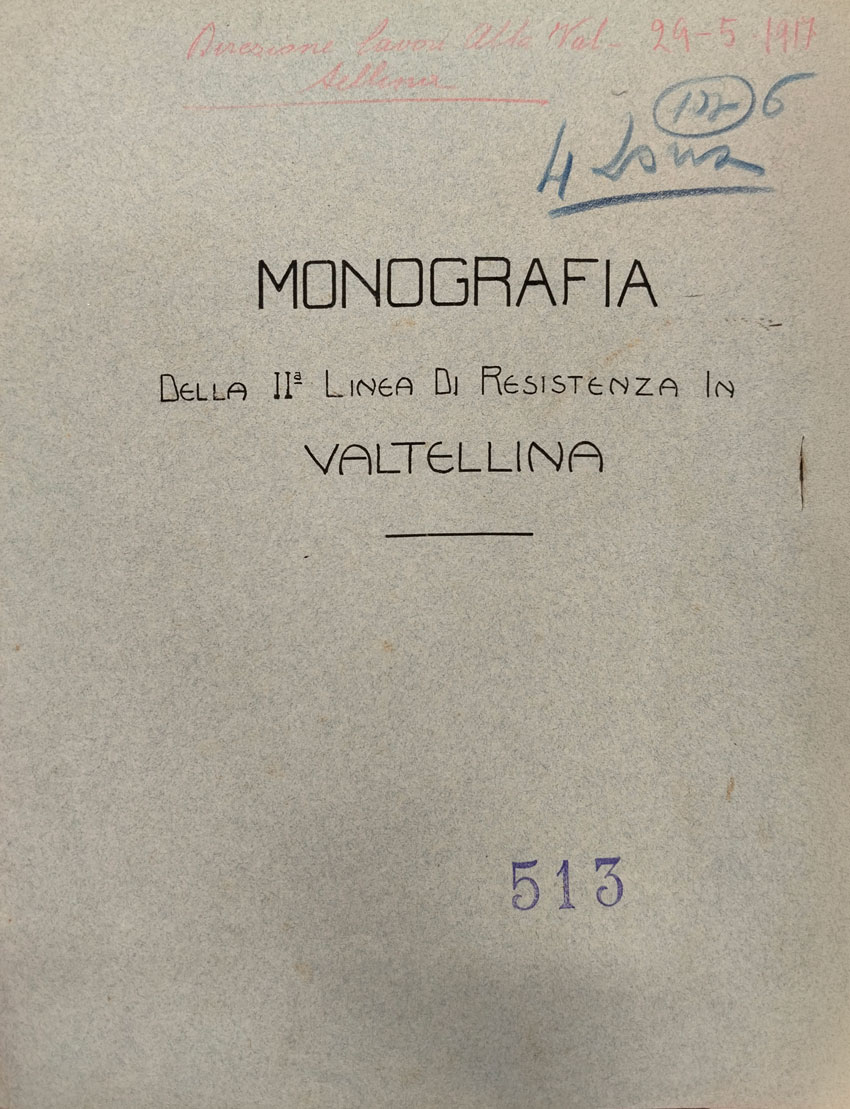
The “Monograph on the Valtellina Second Defensive Line”*
The most important document describing this fortified system is the “Monograph on the Second Defensive Line of the Valtellina”, prepared by the Military Engineers on 29 May 1917. It gives a detailed account of the terrain, the purpose and criteria of the defensive organisation, and the road, telegraph, telephone and cart routes, as well as water-lifting systems, springs and cisterns.
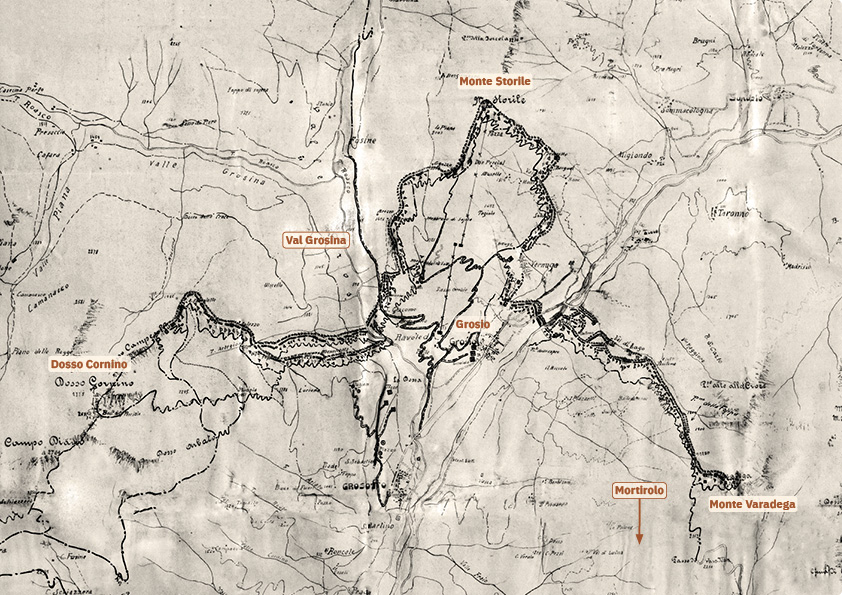

Overall route of the Fortress of Grosio shown on the historical map dated 31 October 1917*
Route of the Grosio defensive line in today’s landscape
Military documents refer to this barrier in several ways: the “Second Defensive Line of the Valtellina”, the “Second Line of Resistance” and, in 1918, the “Third Defensive Line”. We use the second term because, although no fighting took place here and the soldiers of the Grosio detachment remained in the village only briefly, the hundreds of structures and tens of kilometres of barbed-wire entanglements that made up the line clearly embody the idea of determined resistance and of a true defensive fortress, much of which has survived.

Eliana and Remo Canetta, “Grosio and the Great War”
“The Fortress of Grosio” is a project promoted by the Fronti Dimenticati Association and supported by the Municipality of Grosio. It aims to recover and enhance this vast historical heritage, often hidden or forgotten, while placing at its heart the experiences of ordinary people, many of them young, who lived through those conflicts and left their mark on the landscape and collective memory.

Memories in the Trenches**
The project will enhance the sites by clearing and securing the structures, creating historical and cultural routes and educational areas devoted to the Great War, and installing signs and information panels with photographs, historical documents and further details. The aim is to encourage sustainable, educational visits that bring together tourism, culture and landscape.
* Source: Historical and Cultural Institute of the Army Corps of Engineers. Licence no. 8/2026.
Redistribution and publication without authorisation are prohibited.
** Source: Digital image generated using generative AI (ChatGPT/OpenAI, 2025).

With the contribution of


With the contribution of

An initiative supported and sponsored by the Province of Sondrio